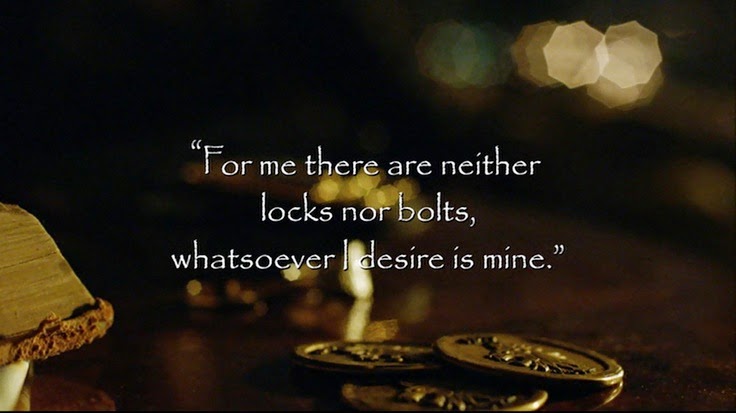
The scene was from the show The Americans*. While I'd be hard pressed to relate this show to fairy tales generally, it makes interesting observations about the human condition, love, despair and choices. The following scene is of the main male character, Philip, with his KGB handler, playing scrabble. Philip, at this point in his journey, is questioning the wisdom of orders given to him and his wife, feeling that it is compromising him as a basic human being - as a father and husband:

[Scene: Philip and his Handler playing scrabble.]
H: Stuck between a geode and a hard place. (shuffles tiles) "Amatory" -(counts points) 24 yes, - 24 -loving , devoted,adoring.
Philip: Where do you come up with this stuff?
H: I love words. They leave a trail. For example, amatory is from the Latin word for 'love'. While wedlock - the condition of being married - is Norse, Norwegian: wed, lock. Which means perpetual battle.
Philip: Your point being?
H: Love and marriage in many ways are antithetical: one is a bolt of lightning, an epiphany, and the other is planting, tilling, tending. It's hard work.
Philip: (glares at H) I'm trying to concentrate here.
H: Oh sorry.
Philip: (puts down scrabble letters)
H: (reads) "sphinx" - excellent. 59 - bravo.**
 Such a great exchange.
He's right. Words leave a trail.
At Myth & Moor yesterday (Terri Windling's wonderfully mythic and inspirational blog) Terri talked about the sense that our stories are disappearing, like many of the world's forests. She was quoting the book Tales Of Faerie and I have started discussing (From the Forest by Sara Maitland) and began by referencing a passage that caught my attention too - about the frustration parents have with the lack of response when they ask their children what happened in their day, ie. "Nothing." My reaction when reading this was so strong I went and grabbed a pencil, underlined it and bookmarked it to read to my husband later.
Using words to tell stories is hard now. We're not only out of the habit, most people don't grow up with this; it's not as common a developmental skill as it used to be. For many, there just isn't time. At least, not to tell stories in that form. For others the gap between everyday expression and "word "smithing is just overwhelming and intimidating. Since oral stories (and general yarns and tale telling) have fallen out of everyday use, being able to tell tales is no longer a common-man thing to do. Whether or not it is true, to many it feels like telling stories are the territory of "true writers" only, so people just... don't. (Using myself as an example, Myth & Moor is full of beautiful, inspirational and thought provoking writing - I highly recommend it - and the comments on Terri's posts range from articulate to poetic - so much so, I often feel unable to comment, certain that I have nothing to add, even though I've always been made welcome there. And this is from someone who does write every day, adores words and has a rudimentary understanding of Latin and other base languages.) As a result, the people who understand those trails of history and stories within the words seem to be fewer and fewer every day. When it comes to tales, people not only get tongue-tied, the stories they stumbling-ly tell, lack vitality, the tales become muddied and, in some ways, they start to die.
 The Grimms were motivated to write down fairy tales because they felt their language and tales were disappearing rapidly in the cultural clime. And they were right. Their work in stopping this from happening altogether is often underestimated but we owe them much.
 People are drawn to the life in words (and trees), to the history in them but it's hard to know, when there is so much in front of us demanding our attention, what we should pay attention to. (Why should we care about this treewhen there are so many more?)
Images help filter. Not too surprisingly, when you figure out it's not really 'words' people don't like, it's the tidal wave of text that feels impossible to process, people can start to sort out just what it is they want to pay attention to - and they go word hunting. Time Magazine, The New York Times, The Washington Post, Christian Science Monitor and many other publications still do exceptionally well publishing multiple page essays. Novels are devoured in print and ebook form alike - perhaps more than ever. People want to read. They want words, and stories and forests and tales. They just want to choose their path so they don't feel so lost.
But how do we get people to the start of these paths and tales so they choose to walk them, themselves and, in doing so, keep them alive?
 That also feels exceptionally difficult to figure out how to do.
(The reason this post has taken as long to get up as it has is due to my search for appropriate visuals to include - and I'll be the first to admit, this whole post would have been better received had I been able to present it in a much more visual manner. I wish I had the skills to pull together reaction gifs and create "visual poems" to capture the essence of what I'm trying to communicate but I didn't grow up that way and don't have those skills... yet.)
It finishes by explaining: "... but the 'nothing' is a cover for "I don't know how to tell a good story about it, how to impose a story shape on the events.' "
 |
| by Banksy (one of my favorites!) |
The Grimms were motivated to write down fairy tales because they felt their language and tales were disappearing rapidly in the cultural clime. And they were right. Their work in stopping this from happening altogether is often underestimated but we owe them much.Today we have the same sense, that stories and tales are disappearing, along with our language. Forget correct grammar, people don't even use full sentences anymore. (See? Just like that.) We resort to catch phrases, memes and emojis to communicate and express sentiments. We summarize in infographics. It's alarming in many ways but the lack of words doesn't mean language and stories are disappearing. It means they're changing shape.
In an age of the internet, in which we need to navigate the constant press of information overload, we've turned the bulk of the words off altogether and begun processing everything the fastest way possible - visually. And it works. After all, visuals are processed 60 000 times faster in the brain than text. We now live in a visual culture and there's no escaping it.
In an age of the internet, in which we need to navigate the constant press of information overload, we've turned the bulk of the words off altogether and begun processing everything the fastest way possible - visually. And it works. After all, visuals are processed 60 000 times faster in the brain than text. We now live in a visual culture and there's no escaping it.
What tends to happen as a result though, is that WE DO LOSE STORIES through the gaps. And tales, and those word shapes with their trails. So what do we do?
 |
| "Knock Knock" by Hilary Leung |
This is something I've been looking at seriously for a good couple of years now - the impact of visual communication and visual consumerism on storytelling. In many ways, this new form of language has opened up new forms of stories to people who weren't interested in telling tales before (for whatever reason). People who always responded with "Nothing" now fill their Tumblr accounts and Pinterest boards with fan-made images and quotes, blending ideas and sentiments, suggesting avenues of thought and inspiring conversation.
"The hyper-visualisation age is now upon us, where any visual media object can act as a portal to other media." (source)
A truly interesting thing (and hidden treasure) is this: the best forms of these new "stories" (however fractured and incomplete they are) lead to words. And more words. The image shorthand is being used like a filtering system in an age of information overload. And the best, most useful "filter caught" images, usually use words too.
Sometimes trying to find what you want is like opening a Matroyshka doll - layers within layers within layers... and sometimes it seems more like hunting Koschei's soul which was hidden inside of a needle, inside of an egg, inside of a duck, inside of a hare, inside of an iron chest,buried under an oak tree, on a island, in the middle of the ocean... but ultimately, the words - and the tales - they're in there.
 |
| by Raquel Aparicio |
A truly interesting thing (and hidden treasure) is this: the best forms of these new "stories" (however fractured and incomplete they are) lead to words. And more words. The image shorthand is being used like a filtering system in an age of information overload. And the best, most useful "filter caught" images, usually use words too.
Sometimes trying to find what you want is like opening a Matroyshka doll - layers within layers within layers... and sometimes it seems more like hunting Koschei's soul which was hidden inside of a needle, inside of an egg, inside of a duck, inside of a hare, inside of an iron chest,buried under an oak tree, on a island, in the middle of the ocean... but ultimately, the words - and the tales - they're in there.
(There are hundreds of articles explaining to business people and marketers just how important the use of images with the right phrase is.) But it can't be just any words. They specifically use 'the right ones', the succinct ones, the ones that, in conjunction with the image, tell a spare story with a lot of resonance; very much like fairy tales always have.
People are drawn to the life in words (and trees), to the history in them but it's hard to know, when there is so much in front of us demanding our attention, what we should pay attention to. (Why should we care about this treewhen there are so many more?) Images help filter. Not too surprisingly, when you figure out it's not really 'words' people don't like, it's the tidal wave of text that feels impossible to process, people can start to sort out just what it is they want to pay attention to - and they go word hunting. Time Magazine, The New York Times, The Washington Post, Christian Science Monitor and many other publications still do exceptionally well publishing multiple page essays. Novels are devoured in print and ebook form alike - perhaps more than ever. People want to read. They want words, and stories and forests and tales. They just want to choose their path so they don't feel so lost.
But how do we get people to the start of these paths and tales so they choose to walk them, themselves and, in doing so, keep them alive?
More specifically, what is a writer to do? How do we preserve our beloved fairy tales from becoming distant memories, footnotes in essays or forgotten tales in out of print books?
The answer is simple. We have to find new ways to tell them.
That also feels exceptionally difficult to figure out how to do. (The reason this post has taken as long to get up as it has is due to my search for appropriate visuals to include - and I'll be the first to admit, this whole post would have been better received had I been able to present it in a much more visual manner. I wish I had the skills to pull together reaction gifs and create "visual poems" to capture the essence of what I'm trying to communicate but I didn't grow up that way and don't have those skills... yet.)
Interestingly, dealing with this exact issue in their own times is, I believe, exactly why the Grimms, Andersen, Perrault and Wilde are still known today. (I have a post on this coming on this shortly - how these fairy tale writers made their tales truly live.)
We know, in principle, that fairy tales are very much a living thing. It's ironic that writing them down to preserve them serves to help them stagnate, almost as if they "solidify" in their written form. Often, it requires these coma-like story forms to get a jolt, usually from another media source, to wake up these 'sleeping beauties' and have people notice and love them again. And perhaps some savvy use of available tools in this "visual era" can help.
 I know. It sounds exhausting and I'm right there with you. Can't we just sit in our corners and write our words and have them there ready for when people want them? I wish we could. But if we want to be part of making sure tales stay alive we need to be active as they're being redefined and retold. We need to be part of the 'telling'. The best historians don't just dig into the dusty past and tell us what happened, they explain why things happened the way they did and show us the direct connection to ourselves, how we can learn from history to learn about the world as it is now and to make a better future. Otherwise why bother with history at all?
Eventually, when the noise of the world is sorted and people know what they want to focus on, words become even more precious than before. It's then that they ask for more words, more tales.
People will continue to come back to words. The trick is to keep the trail visible.
I know. It sounds exhausting and I'm right there with you. Can't we just sit in our corners and write our words and have them there ready for when people want them? I wish we could. But if we want to be part of making sure tales stay alive we need to be active as they're being redefined and retold. We need to be part of the 'telling'. The best historians don't just dig into the dusty past and tell us what happened, they explain why things happened the way they did and show us the direct connection to ourselves, how we can learn from history to learn about the world as it is now and to make a better future. Otherwise why bother with history at all?Eventually, when the noise of the world is sorted and people know what they want to focus on, words become even more precious than before. It's then that they ask for more words, more tales.
People will continue to come back to words. The trick is to keep the trail visible.
____________________________________________________________________
For those looking to learn more about this 'visual era', here's a short list (really!) to get you started, The ones with the orange stars are super quick, informative skims. The purple stars are recommended reads over the rest if you're short on time:
The Guardian: The New (Visual) Culture: how to produce quality in a world of quantity
*WallBlog: Turning advertising into a service: brands must embrace the hyper-visual landscape
*Social Media Examiner: 4 Businesses Leveraging Storytelling With Images
* Business 2 Community: Why Image Trumps Everything in Today's Visual Age
FastCompany: The Rise of Visual Social Media
Marketing Magazine: Brands Should Take the Visual Web Seriously, says Facebook's EMEA Boss
* Cyber Alert: Visual Storytelling Campaigns That Inspire, Motivate and Generate Action
MindFire Communications: It's A Visual World. Show Your Story
* LinkedIn: Market Researchers: Do you Speak Visual?
* MDG Advertising: It's All About the Images (Infographic)
* Wishpond Advanced Lead Generation Marketing Blog: 10 Reasons Visual Content Will Dominate 2014
SteamFeed: Why Visual Content Will Rule Digital Marketing in 2014
NeonTommy: Visual Poetry Collection 'Kern' Meshes Literature And Art

The Guardian: The New (Visual) Culture: how to produce quality in a world of quantity
*WallBlog: Turning advertising into a service: brands must embrace the hyper-visual landscape
*Social Media Examiner: 4 Businesses Leveraging Storytelling With Images
* Business 2 Community: Why Image Trumps Everything in Today's Visual Age
FastCompany: The Rise of Visual Social Media
Marketing Magazine: Brands Should Take the Visual Web Seriously, says Facebook's EMEA Boss
* Cyber Alert: Visual Storytelling Campaigns That Inspire, Motivate and Generate Action
MindFire Communications: It's A Visual World. Show Your Story
* LinkedIn: Market Researchers: Do you Speak Visual?
* MDG Advertising: It's All About the Images (Infographic)
* Wishpond Advanced Lead Generation Marketing Blog: 10 Reasons Visual Content Will Dominate 2014
SteamFeed: Why Visual Content Will Rule Digital Marketing in 2014
NeonTommy: Visual Poetry Collection 'Kern' Meshes Literature And Art
* It's one of the few shows I think is brilliantly done in every aspect and which I do my best to keep up with, even if I can only see 10 minutes of a show at a time. It's very brutal at times but I love the juxtaposition of a couple working on their relationship and raising an American family against the background of being KGB spies in America.
** I thought the riddle response was a great touch too.